I've been here 5 days now and have finally settled in. The only thing I'm missing is tennis shoes and sweat pants/shorts/shirts which you can only buy at the commissary on Monday nights 7-8p CST. This just happens to coincide with the final episode of Prison Break for season 2. I chose Prison Break. Therefore, no shoes or sweats.
I'm a little wiser already after 5 days then I was after the first two days. While I still think I can learn a lot from these guys, I'm having to be more selective with whom I interact. Some of these guys are not just "in" prison, they are "of" prison; they have become institutionalized. I try to understand them, but there's nothing about them that invites communication. They've given up, checked out; their souls seem to have died.
On the other hand, I met a guy today who is 19 years into a 27 year sentence. He is 51 and with "good time" will be out in 2 years. I don't know what he did but I'm sure it was drug-related and for the sentence to be that high, he must have received additional enhancements for volume or firearms or conspiracy, or something like that. He cannot have had a record of violence or he would not be allowed to finish his time in this camp. I just don't get these kind of sentences.
He is intelligent and humble. We connected. I asked him who he blamed, and he said, "I blame me." Of course, in a sense, he is correct and that is also the politically correct answer but it's hard to understand how it justifies the punishment he received.
I asked him how he deals with the bitterness and he said he prays. He converted to Islam in prison. He also shared personal details about the effect on his relationship to his family that I will not repeat here, but it was excruciating to hear.
To add insult to injury he was originally sentenced 1 year after the US Sentencing Guidelines (USSG) went into effect. Had he been sentenced a year earlier, he believes he would have received probation. Try doing 27 years with that on your mind.
Thursday, April 26, 2007


White Collar Room
It's 6:15a Monday morning. I'm in the library. I missed breakfast. I haven't eaten since 3:30p yesterday. Breakfast on weekdays is served from 5:00 - 6:00a. I woke at 5:30a, showered and dressed only to hear the intercom announce: "The dining hall is now closed." Nice.
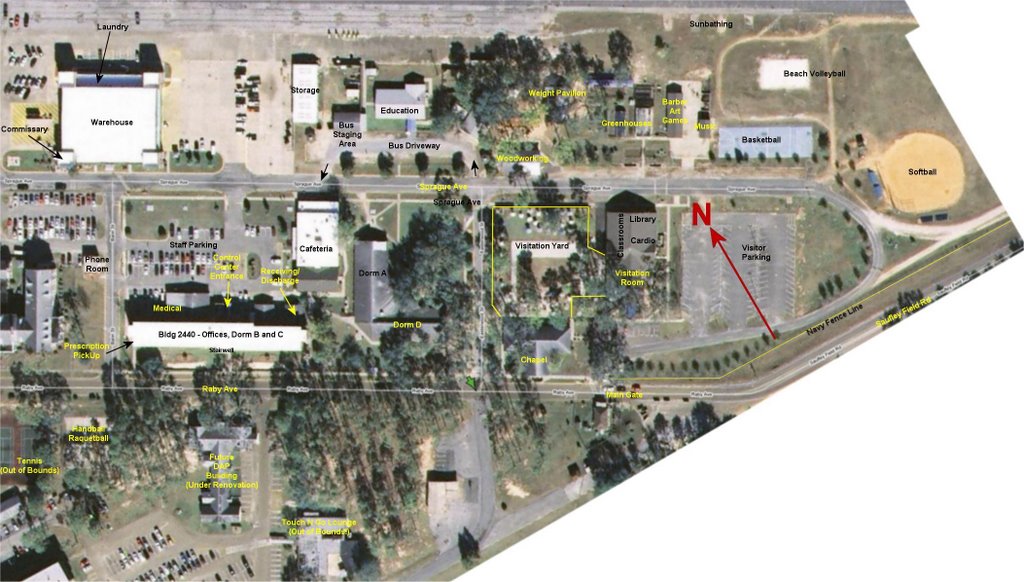
So now I'm in the library, specifically the law library, which is a room off the main library [see maps at bottom of page]. I usually write in this room because it has good tables, comfortable chairs, newspapers, and ... white collar criminals, like me, as I discovered this weekend. It does not mean they are better, just more like me. No one wears white collars or blue collars here in prison, at FPC Pensacola we all wear green.
Advertising fraud. Tax fraud. Bank fraud. Mail fraud. Wire fraud. (I seem to be the only "hacker" around.)
According to the inmates I have spoken with, 80 - 90 % of the population here are drug offenders; the remainder are in for white collar offenses. Additionally, 60% are black, 20% Hispanic and 20% white (a subject I will write on later).
Virtually all the drug offenders will acknowledge they were guilty and they knew they were breaking the law (although they were generally unaware of how stiff the US Sentencing Guidelines are when it comes to drug offenses, especially when conspiracy and guns are involved).
The white collar guys are all "innocent." Not technically innocent, because there was probably some law they didn't know about that they violated, but they claim that government lost "perspective" in their case, the system abused them, and they were unaware of the possible drastic consequences of their actions.
Most white collar crimes are business crimes so most white collar criminals view every problem as a "business", not a legal or ethical, issue. Business problems are resolved through negotiation, compromise, and eventually, if necessary, money. It probably goes without saying that our legal system doesn't work that way.
It is very difficult - I can certainly understand - for most white collar defendants to wrap their minds around the idea that they did something that could warrant prison time. The denial and resistance continues even in prison. That is why they are here in the law library -- trying to figure out some way to reverse what has happened to them.
Good luck.
So now I'm in the library, specifically the law library, which is a room off the main library [see maps at bottom of page]. I usually write in this room because it has good tables, comfortable chairs, newspapers, and ... white collar criminals, like me, as I discovered this weekend. It does not mean they are better, just more like me. No one wears white collars or blue collars here in prison, at FPC Pensacola we all wear green.
Advertising fraud. Tax fraud. Bank fraud. Mail fraud. Wire fraud. (I seem to be the only "hacker" around.)
According to the inmates I have spoken with, 80 - 90 % of the population here are drug offenders; the remainder are in for white collar offenses. Additionally, 60% are black, 20% Hispanic and 20% white (a subject I will write on later).
Virtually all the drug offenders will acknowledge they were guilty and they knew they were breaking the law (although they were generally unaware of how stiff the US Sentencing Guidelines are when it comes to drug offenses, especially when conspiracy and guns are involved).
The white collar guys are all "innocent." Not technically innocent, because there was probably some law they didn't know about that they violated, but they claim that government lost "perspective" in their case, the system abused them, and they were unaware of the possible drastic consequences of their actions.
Most white collar crimes are business crimes so most white collar criminals view every problem as a "business", not a legal or ethical, issue. Business problems are resolved through negotiation, compromise, and eventually, if necessary, money. It probably goes without saying that our legal system doesn't work that way.
It is very difficult - I can certainly understand - for most white collar defendants to wrap their minds around the idea that they did something that could warrant prison time. The denial and resistance continues even in prison. That is why they are here in the law library -- trying to figure out some way to reverse what has happened to them.
Good luck.
Wednesday, April 25, 2007
How I Blog from Prison
Some of you may wonder how I am able to blog from prison. No, I do not have access to the internet!
The prison supplies inmates with tablets of lined paper and envelopes. I write my blog entries on the front and back to save on stamps. I have worn quite a callous on the side of my finger. In a little over 2 weeks I have probably written 80 pages [not all have been posted at this time, be patient, they are coming!] .
It is more difficult than typing, because editing is time consuming. I generally write in "stream-of-consciousness" mode, putting on paper what I am thinking. I have to scratch through errors and write corrections in the margin or squeeze between the lines. As opposed to my usual writing mode on a computer, where I can easily review and rearrange whole sections, editing large sections on paper just takes time -- but I do have lots of that.
I generally write several entries from beginning to end until my hand can't go any farther (or until I run out of time and have to retire for the evening). I try to write entries within a day or two of the event or idea to keep it fresh and accurate. I then re-read them the next day, making minor edits.
Like most writers, I am rarely satisfied with these slightly edited first drafts, but I don't have time to "tighten" them up so I let them go as is. In most cases, they are way too wordy. Given more time, I could improve them, like reducing an algebraic equation to its most efficient form. Perhaps when I get out, I will review them and make needed improvements.
The other feature of blogging that makes it different from traditional journaling is the ability to include internal and external links to phrases and references in a post. I will go back and add these when I get out.
Finally, I package all my entries and send them to my wife, who posts them for me. She has been supportive of this project and has full authority to edit or not post an entry she deems inappropriate. I can send 6 pages in each envelope for the price of one stamp. I usually send 3 or 4 letters at a time 2 or 3 times a week. That is a lot of typing for her, especially since she has to type from my handwriting!
The end result is a 7-10 day delay from when an idea strikes me to when I can write about it, mail it, and have my wife post it.
There is no shortage of ideas, although this may slow down as I settle in and start working a full five days a week, but that will mean I can write more about funny/interesting/unique incidents rather than merely describing some of the more routine aspects of life here.
I really have two audiences: friends and family who want to keep up with how I am doing and strangers who are facing prison time and looking for very specific details about prison life in general and prison camps in particular. The second audience is the reason I will post some lengthy, but perhaps dry, entries about very specific details of an aspect of prison life, such as the dormitories, commissary, food, visitation, etc.
In any case, this project is unique I believe. I don't know of another inmate who has attempted to chronicle on-line the real-time personal details of his experience in prison.
I hope you enjoy it.
The prison supplies inmates with tablets of lined paper and envelopes. I write my blog entries on the front and back to save on stamps. I have worn quite a callous on the side of my finger. In a little over 2 weeks I have probably written 80 pages [not all have been posted at this time, be patient, they are coming!] .
It is more difficult than typing, because editing is time consuming. I generally write in "stream-of-consciousness" mode, putting on paper what I am thinking. I have to scratch through errors and write corrections in the margin or squeeze between the lines. As opposed to my usual writing mode on a computer, where I can easily review and rearrange whole sections, editing large sections on paper just takes time -- but I do have lots of that.
I generally write several entries from beginning to end until my hand can't go any farther (or until I run out of time and have to retire for the evening). I try to write entries within a day or two of the event or idea to keep it fresh and accurate. I then re-read them the next day, making minor edits.
Like most writers, I am rarely satisfied with these slightly edited first drafts, but I don't have time to "tighten" them up so I let them go as is. In most cases, they are way too wordy. Given more time, I could improve them, like reducing an algebraic equation to its most efficient form. Perhaps when I get out, I will review them and make needed improvements.
The other feature of blogging that makes it different from traditional journaling is the ability to include internal and external links to phrases and references in a post. I will go back and add these when I get out.
Finally, I package all my entries and send them to my wife, who posts them for me. She has been supportive of this project and has full authority to edit or not post an entry she deems inappropriate. I can send 6 pages in each envelope for the price of one stamp. I usually send 3 or 4 letters at a time 2 or 3 times a week. That is a lot of typing for her, especially since she has to type from my handwriting!
The end result is a 7-10 day delay from when an idea strikes me to when I can write about it, mail it, and have my wife post it.
There is no shortage of ideas, although this may slow down as I settle in and start working a full five days a week, but that will mean I can write more about funny/interesting/unique incidents rather than merely describing some of the more routine aspects of life here.
I really have two audiences: friends and family who want to keep up with how I am doing and strangers who are facing prison time and looking for very specific details about prison life in general and prison camps in particular. The second audience is the reason I will post some lengthy, but perhaps dry, entries about very specific details of an aspect of prison life, such as the dormitories, commissary, food, visitation, etc.
In any case, this project is unique I believe. I don't know of another inmate who has attempted to chronicle on-line the real-time personal details of his experience in prison.
I hope you enjoy it.
Subscribe to:
Posts (Atom)